 PORTUGAL ASHORE: OUR LIST OF EXCLUSIVE PERSONALIZED SHORE EXPERIENCES FOR DISCERNING TRAVELERS
There are essentially two ways to visit a European port. One is to board a motorcoach with forty-seven people, receive a numbered sticker and spend the next six hours developing an unexpectedly intimate relationship with the gentleman in Row 3.
The other is to have a car, a driver and an excellent guide waiting for you when you leave the ship.
Churchill & Turen Ltd., along with our partner, Abercrombie & Kent, currently ranked the Top Worldwide Tour Operator for intelligent travelers, has sensibly decided that there may be a market for the latter.
A&K’s European shore-excursion operation offers private excursions for cruise passengers arriving at more than fifty European ports. The important word is private: these are designed for the guest’s own party and can generally be customized.
In Portugal, the two shore excursions A&K specifically documents in its European portfolio are Lisbon — Sintra, Queluz & Estoril and Highlights of Porto.
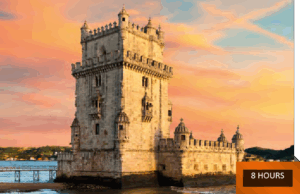
TOUR PCT # 1 -LISBON
SINTRA, QUELUZ & ESTORIL
Duration: 8 hours — Full Day
Transportation: Private luxury car or minivan
Guide: Private A&K local guide throughout
Price: A&K does not currently publish a fixed retail price. Our planning estimate: approximately $1,000–$1,600 per private vehicle/party, depending upon number of guests, vehicle category, entrances and date. This is an estimate for budgeting purposes, not an A&K quoted price.
This is the serious Lisbon excursion.
Rather than attempting to see Portugal through the window of a bus moving at approximately the speed required to return everyone to the ship before it sails, A&K heads into the countryside.
The destination is Sintra, the summer retreat of Portuguese royalty and one of those rare UNESCO World Heritage Sites that actually looks as though it deserves the designation.
Sintra sits amid wooded hills outside Lisbon, populated by palaces, villas and gardens created by generations of Portuguese aristocrats who apparently regarded architectural restraint as a character defect.
From Sintra, the excursion continues to Queluz Palace, the former summer residence of Portugal’s royal family.
Queluz is frequently called the “Portuguese Versailles.” This is travel-writing shorthand for large European palace containing considerably more gold leaf than is strictly necessary.
But Queluz deserves better.
It is intimate enough to understand how the Portuguese royal family actually lived and sufficiently grand to remind visitors that these were people who did not have to ask what things cost.
The day also incorporates the Estoril area before returning to Lisbon.
OUR VIEW: Best A&K choice for the first-time visitor to Lisbon who has a genuine full day in port. Eight hours is important. Sintra is not an excursion we recommend squeezing into a four-hour port window. Crowds and traffic can be significant, and this is precisely where private transportation and a knowledgeable guide earn their keep.
Best for: History, architecture, culture and first-time visitors.
Walking: Moderate. Historic paving, steps and inclines should be expected.
Worth the money? For four guests sharing the private arrangement, potentially very much so. The cost-per-person differential versus four premium ship excursions may be smaller than clients initially assume.

TOUR PCT # 2 – LISBON FOR THE REPEAT VISITOR
PRIVATE LISBON — BELÉM, JERÓNIMOS & THE AGE OF DISCOVERY
Suggested duration: 4 hours — Half Day
Price: Quote required. Planning estimate: $650–$1,000 per private party, depending upon vehicle, guide and included admissions.
This is where we would depart slightly from the “see everything because the ship leaves at six” school of tourism. Lisbon is worth actually seeing.
The natural focus is Belém, where Portugal’s extraordinary maritime history comes into view through Jerónimos Monastery, Belém Tower and the monuments associated with the country’s Age of Discovery.
This is the Portugal of Vasco da Gama, global navigation and an era when a relatively small country on Europe’s western edge managed to become one of the most consequential maritime powers on earth. A good private guide makes an enormous difference here. Without one, visitors see an attractive monastery.
With one, they begin to understand how Portugal once managed to have Brazil, parts of Africa and trading posts across Asia on its corporate organizational chart.
And then there is the pastel de nata. One should never underestimate a civilization capable of turning egg custard into a national institution.
OUR VIEW: For sophisticated repeat visitors—or anyone who dislikes racing around Europe collecting monuments—four excellent hours in Lisbon may be preferable to eight frantic ones everywhere else.
TOUR PCT # 3 – PORTO
HIGHLIGHTS OF PORTO
Duration: 4 hours — Half Day
Transportation: Private luxury car or minivan
Guide: Private A&K local guide throughout
Price: A&K quote required. Our planning estimate: approximately $650–$1,000 per private party.
Here A&K gets the timing exactly right. Four hours. Not nine. Not eleven.
Not “approximately eight hours depending upon traffic,” which is cruise-excursion language for bring medication.
The excursion explores Porto’s historic center, including the magnificent Stock Exchange Palace and St. Francis Church.The Stock Exchange Palace is gloriously ornate. St. Francis Church is even more so.
Anyone who has ever wondered whether it is possible to decorate an interior using too much gold should visit before reaching a conclusion.
The excursion then proceeds to Porto’s Ribeira district for the activity that has made generations of visitors suddenly much more interested in Portuguese history:
Port tasting.
Guests visit one of the famous riverside port lodges and sample the product that made Porto internationally famous.
OUR VIEW: This may be the best-balanced A&K Portugal shore excursion. It contains history, architecture, local culture and wine, yet it does not consume the entire port call.
Guests can return to the ship for lunch—or remain ashore and demonstrate further commitment to Portuguese viticulture.
Best for: First-time Porto visitors, wine enthusiasts and clients who dislike marathon sightseeing.
Walking: Moderate. Porto has hills and uneven paving.
TOUR PCT # 4 – PORTO FOR FOOD LOVERS
MARKETS, PETISCOS & BACKSTREET PORTO
Likely duration: approximately 4 hours
Price: Quote required. Planning estimate: approximately $700–$1,100 per private party, particularly if food and wine tastings are included.
Churchill & Turen is pleased to offer a culinary alternative in Porto built around its central market and backstreet taverns. This is the excursion we would choose for clients who have already visited Porto.
Rather than another procession through historic interiors, the emphasis shifts toward how Porto actually eats. Guests encounter local markets and petiscos—small Portuguese dishes that inevitably get described as “Portuguese tapas.”
We advise against saying this within earshot of either a Portuguese or a Spaniard.
OUR VIEW: Possibly the most interesting Porto excursion for experienced travelers. Markets tell us considerably more about a city than souvenir shops do, and food tours have the useful advantage that almost nobody asks, halfway through lunch, “How much longer until we get back to the bus?”
TOUR PCT # 5 – THE DOURO VALLEY
WINE COUNTRY, ESTATE VISIT, TASTING & LUNCH
Suggested duration: 8 hours — Full Day
Price: Quote required. Planning estimate: approximately $1,200–$1,900 per private party, depending upon winery, lunch arrangements and vehicle.
This is the excursion we would most want to take ourselves. The Douro Valley is one of Europe’s great wine landscapes: vineyard terraces climbing improbably steep hillsides above the Douro River, punctuated by wine estates that have been producing port for generations.
A proper full-day private excursion allows time for a wine estate, tastings and lunch without turning the experience into competitive sightseeing.
OUR VIEW: Potentially the finest day ashore in northern Portugal—but only with sufficient port time. We would want approximately eight hours available and a healthy margin before the ship’s departure.
A beautiful lunch overlooking the Douro becomes somewhat less beautiful when everyone at the table begins checking their watches.
Best for: Wine enthusiasts, experienced travelers and clients who value landscape and gastronomy more than monument collecting.
TOUR PCT # 6 – PORTIMÃO / ALGARVE
PONTA DA PIEDADE & THE ALGARVE COAST
Likely duration: 4 hours — Half Day
Estimated private-tour budget: approximately $700–$1,100 per party, depending upon boat arrangements and group size.
The Algarve provides a useful antidote to the European cruise itinerary in which guests have visited seventeen churches by Thursday. Here the attractions are geological.
Small boats explore the cliffs, coves and sea caves around Ponta da Piedade, one of southern Portugal’s most dramatic stretches of coastline.
No royal bedrooms. No cathedral ceilings. No guide explaining which Habsburg married which Bourbon.
Just limestone, Atlantic water and some exceedingly photogenic coastline.
OUR VIEW: On a sunny day, take the boat. On a rough day, don’t.
Luxury travel occasionally requires accepting that the Atlantic Ocean has not read the itinerary.
TOUR PCT # 7 – INLAND ALGARVE
SILVES & LOULÉ
Likely duration: 4–5 hours — Half Day
Estimated private-tour budget: approximately $700–$1,050 per party.
This is our choice for clients who want to understand the Algarve rather than simply photograph it. Silves provides the historical substance, with its significant Moorish heritage. Loulé provides something equally valuable: a Portuguese town in which people actually live.
The result is a welcome alternative to the beach resorts and golf developments that have come to define much of the Algarve internationally.
OUR VIEW: Our preference for culturally sophisticated travelers. The coast is prettier. The interior is more interesting.
A NOTE ABOUT PRICING
Abercrombie & Kent does not publish standard retail prices for these private European shore excursions in its shore-excursion portfolio. That makes sense because a private excursion for two guests in a Mercedes sedan is a different product from an excursion for six guests requiring a luxury minivan. Churchill & Turen has partnered with Abercrombie & Kent because, unlike other firms that claim to do sightseeing programs for the luxury cruise market, these tours stand alone in the sense that they are not, like the online shore excursion purveyors, designed for mass-market mega-ship passengers. Our one-of-a-kind European Shore Excursion Collection is purposefully designed for those who want the best available experiences on the ground.
Prices can also vary according to:
- Number of guests
- Vehicle required
- Guide
- Admissions
- Meals and wine tastings
- Date and season
- Port location
- Requested customization
Therefore, the dollar amounts in this report should be regarded strictly as Churchill & Turen planning estimates—not published A&K prices.
Before quoting a client, we would obtain the actual price for the specific ship, port date and number of guests.
THE BOTTOM LINE
What A&K is really selling here isn’t Sintra.
Sintra has been there for quite some time.
Nor is it selling Porto, the Douro or the Algarve.
It is selling control. A private vehicle. A professional guide. An itinerary designed around the client rather than forty other passengers.
And perhaps most importantly, somebody who understands that when the ship sails at 6:00 p.m., explaining to the captain that there was traffic outside Sintra is unlikely to produce the desired result.
For our clients, that is the real attraction.
The luxury isn’t necessarily the Mercedes. The luxury is not waiting for forty-seven people to get back on the bus, knowing you are in the hands of certified drivers and Guides who meet the industry’s most exacting standards.
THE TOTALLY UNOFFICIAL INSIDER’S GUIDE TO SEEING THE REAL LISBON
By Richard Bruce Turen

(Rick Steves had absolutely nothing to do with this project)
Lisbon is a city of seven hills, twelve thousand tiles, and approximately one million tourists trying to photograph those tiles. But beneath the pastel façades and the tuk‑tuks (yes, Lisbon has tuk‑tuks now; no, we’re not talking about it), lies a city that rewards the traveler who wanders off the “Top 10 Things To Do in Lisbon” list and into the places where Lisboetas actually live, eat, argue, and pretend not to notice the cruise ship docking.
NEIGHBORHOODS WHERE LISBON STILL FEELS LIKE LISBON
Campo de Ourique
Lisbon’s most quietly smug neighborhood. No tourists, no chaos, just elegant old ladies walking tiny dogs and bakeries that have never once posted a photo of their pastries on Instagram. The market is superb, the cafés are civilized, and the vibe is “I live here because I’m better than you.”
Mouraria
The birthplace of fado and the last place in Lisbon where you can still get lost in alleys that seem designed specifically to confuse Google Maps. It’s gritty, multicultural, and gloriously unpolished. If Alfama is the Disney version of old Lisbon, Mouraria is the arthouse film.
Estrela
Home to the basilica, the park, and the kind of genteel residential calm that makes you wonder if everyone here is secretly retired. Perfect for travelers who want to stroll, sit, read, and judge others for rushing.
Alcântara (Beyond LX Factory)
LX Factory is fun, but the real Alcântara is the waterfront warehouses, the tiny taverns, and the old men playing cards outside cafés that have never heard of oat milk.
SHOPPING FOR PEOPLE WHO DON’T WANT TO BE SEEN SHOPPING
A Vida Portuguesa
A temple of Portuguese nostalgia where everything is beautiful, tasteful, and designed to make you feel like your own country has no aesthetic standards whatsoever.
Embaixada (Príncipe Real)
A 19th‑century palace turned concept store. You will buy something here. You will not need it. You will justify it anyway.
Luvaria Ulisses
A glove shop so tiny and so elegant that entering it feels like stepping into a Wes Anderson film. You will buy gloves. You will not wear them. You will cherish them.
The Real Shopping: Neighborhood Markets
Mercado de Campo de Ourique, Mercado de Arroios, Mercado de Alvalade — where locals actually shop and where you can buy cheese from someone who will judge you for not knowing which region it’s from.
RESTAURANTS TOURISTS MISS (BECAUSE THEY’RE TOO BUSY WAITING AT RAMIRO)
Zé da Mouraria
A no‑nonsense tavern serving traditional Portuguese dishes in portions designed for longshoremen. Zero pretense. Maximum authenticity.
O Magano (Campo de Ourique)
Alentejo cuisine done properly. If you want to understand Portuguese comfort food, this is your classroom.
Tasquinha do Lagarto
A beloved local spot where the food is hearty, the service is warm, and absolutely no one is taking photos of their plate.
Pateo Alfacinha
A charming, slightly theatrical village‑within‑the‑city that somehow remains under the radar. Great for lunch, better for people‑watching.
SIGHTS THAT AREN’T ON THE “TOP 10” LIST (THANK GOD)
The Water Museum (Museu da Água)
A gorgeous 19th‑century pumping station that looks like a steampunk cathedral. Tourists never go. Their loss.
The Tile Museum (Museu Nacional do Azulejo)
Yes, tiles. Thousands of them. It’s magnificent. And blissfully quiet.
Jardim Botânico da Ajuda
A historic botanical garden with peacocks who behave like they own the place. They do.
The Cemetery of Pleasures (Cemitério dos Prazeres)
Lisbon’s most beautiful cemetery. Peaceful, atmospheric, and oddly uplifting.
TEN THINGS ABOUT LISBON THEORETICALLY WORTH KNOWING
- Lisbon has seven hills, all of which you will climb accidentally. The city is basically a StairMaster with better seafood.
- Every local café has a pastry that is “the best in Lisbon,” and every Lisboeta will die on that hill.
- The trams are charming until you realize they were designed for people who are 4’11” and weigh 90 pounds.
- Lisbon drivers park in ways that defy physics, legality, and common sense. Parallel parking is a suggestion, not a rule.
- The sidewalks are made of tiny polished stones specifically engineered to destroy your ankles. Lisbon is beautiful; Lisbon is slippery.
- Every restaurant has a waiter who will insist you order the dish you didn’t want. And they’re right. They’re always right.
- The city’s official bird is the seagull, whose hobbies include screaming, stealing food, and judging tourists.
- Lisbon’s elevators and funiculars exist solely to remind you that you should have taken them.
- The tuk‑tuks are multiplying. No one knows why. No one knows how. They simply appear.
- Lisbon’s weather is perfect until the exact moment you decide to wear linen. Then the wind arrives.
HOW CHURCHILL & TUREN GUESTS CAN BEHAVE LIKE A LOCAL IN LISBON
A field manual for sophisticated travelers who wish to blend in, not stand out, and certainly not be mistaken for someone waiting in line at Pastéis de Belém.
- Walk Like You Have Nowhere to Be.
Lisboetas stroll. They do not rush. They do not power‑walk. They do not jog unless they are wearing Lycra and clearly on a mission. If you move slowly and look mildly contemplative, you’re already halfway there.
- Order Coffee Correctly.
There is no “latte.” There is no “flat white.” There is no “extra hot oat milk caramel cloud.” There is bica (espresso), meia de leite (half milk, half coffee), and galão (the tall one). Order confidently. Sip slowly. Judge silently.
- Accept That Bread Arrives Unasked.
In Lisbon, bread appears the way plot twists appear in Portuguese telenovelas: suddenly and without explanation. You will be charged for it. You will eat it anyway. This is the way.
- Speak Softly.
Lisboetas do not shout unless Benfica is playing. Keep your voice at a pleasant murmur, as if you’re sharing state secrets or complaining about the humidity.
- Pretend You Don’t Care About the View.
Yes, the miradouros are stunning. Yes, the city looks like a watercolor painting. But locals glance at the view the way New Yorkers glance at the Empire State Building — with a faint, weary acknowledgment that it exists.
- Know That Lines Are Optional.
Lisbon queues are more conceptual than literal. They are loose gatherings of humans who have agreed, vaguely, to wait. Stand near the line. Not in it. Not outside it. Near it. You’ll know when it’s your turn.
- Eat Fish Like You Mean It.
If you order sardines, do not flinch. Do not ask for fillets. Do not request “boneless.” You eat the sardine. You deal with the bones. You earn respect.
- Master the Art of the Discreet Eye Roll.
This is essential for tuk‑tuks, loud tourists, and anyone who calls Lisbon “the new Barcelona.” The eye roll should be subtle, elegant, and visible only to those who deserve it.
- Dress Like You Might Be Cast in a European Indie Film.
Lisbon style is effortless: linen, neutrals, tasteful jewelry, shoes that suggest you walk but do not hurry. If your outfit says “I am comfortable and also possibly a poet,” you’re doing it right.
- Never, Ever Call It “Lisboa.”
Locals call it Lisbon when speaking English. Tourists call it Lisboa to sound worldly. Do not be that tourist.
BONUS: THE LISBON LOCAL’S CODE OF HONOR
(A few unwritten rules that will help you pass as someone who actually lives here.)
- You must have a strong opinion about which pastel de nata is best. It doesn’t matter if you’re wrong. You must have the opinion.
- You must complain about the hills while simultaneously bragging about them. This is cultural.
- You must know at least one shortcut that involves stairs, alleys, or a questionable ramp. Locals navigate Lisbon like it’s a video game.
- You must pretend not to notice the cruise ship crowds. Even when they are directly in front of you.
- You must treat the Tagus River as a personality. It is moody. It is beautiful. It is windy. It is always right.